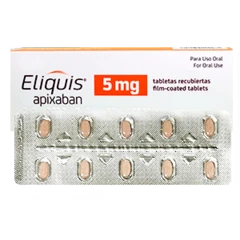
Apixaban
Apixaban is an oral anticoagulant, sold under the brand name Eliquis as a film-coated tablet. According to the US prescribing information, it is used to reduce the risk of stroke and blood clots travelling through the bloodstream in adults with nonvalvular atrial fibrillation, to prevent deep vein thrombosis after hip or knee replacement surgery, and to treat deep vein thrombosis and pulmonary embolism, including reducing the risk of them recurring after initial treatment.
Key points
- ELIQUIS carries a boxed warning that stopping it early, for a reason other than a bleeding problem or completing planned treatment, increases the risk of a blood clot.
- Once absorbed, apixaban has a total clearance of approximately 3.3 L/hour and an apparent half-life of approximately 12 hours after it is taken by mouth.
- Apixaban is metabolised mainly via the liver enzyme CYP3A4, with minor contributions from CYP1A2, 2C8, 2C9, 2C19 and 2J2.
- Common adverse reactions to apixaban, each reported in at least 1% of patients, include gum bleeding, nosebleeds, bruising, blood in the urine, rectal bleeding, bruising under the skin (haematoma), heavier menstrual bleeding and coughing up blood.
How it works
Apixaban is a potent, oral, reversible, direct and highly selective inhibitor of the clotting protein factor Xa, and does not need antithrombin III to produce its antithrombotic effect, according to the UK Summary of Product Characteristics. It blocks factor Xa whether that factor Xa is free or already bound within a clot, and also blocks the prothrombinase enzyme complex; it has no direct effect on platelets, but indirectly reduces the platelet clumping that thrombin triggers. By inhibiting factor Xa, apixaban reduces the amount of thrombin generated and slows the growth of blood clots.
Safety specific to apixaban
Stopping ELIQUIS early, for any reason other than a bleeding problem or completing a planned course of treatment, increases the risk of a blood clot forming; if that happens, the label advises considering cover with another anticoagulant.
ELIQUIS also carries a boxed warning about spinal bleeding. Anyone treated with ELIQUIS who has a spinal injection (neuraxial anaesthesia) or a spinal procedure such as a lumbar puncture can develop a blood clot around the spinal cord, an epidural or spinal haematoma, which may cause long-term or permanent paralysis, so this risk is weighed up carefully whenever such a procedure is being scheduled. That risk is higher with an epidural catheter left in place, with the concomitant use of other medicines that affect blood clotting such as NSAID painkillers, platelet inhibitors or other anticoagulants, with a past history of a difficult or repeated spinal or epidural puncture, and with a history of spinal deformity or previous spinal surgery.
Beyond the spinal risk, ELIQUIS increases the risk of bleeding generally and can cause serious, potentially fatal, bleeding. A specific reversal agent, andexanet alfa, that counteracts apixaban’s effect is available for adults.
ELIQUIS is not given to anyone with active, clinically significant bleeding, or with liver disease that involves a clotting problem (coagulopathy) alongside a clinically relevant bleeding risk, according to the UK Summary of Product Characteristics. It is also avoided where a lesion or condition is considered a significant risk factor for major bleeding, which can include current or recent gastrointestinal ulceration, cancers at high risk of bleeding, recent brain, spinal or eye injury or surgery, a recent bleed inside the skull, known or suspected oesophageal varices, arteriovenous malformations, vascular aneurysms, or major abnormal blood vessels in or around the spine or brain.
The safety and efficacy of ELIQUIS have not been studied in patients with prosthetic heart valves. Direct-acting oral anticoagulants, including ELIQUIS, are also not recommended for patients with triple-positive antiphospholipid syndrome.
When to seek urgent care
The optimal timing between taking ELIQUIS and having a spinal or epidural procedure is not known, so anyone in this position needs frequent monitoring for signs and symptoms of neurological impairment afterwards; if any such signs appear, the label states that urgent treatment is necessary. Doctors weigh the benefits and risks of a neuraxial procedure carefully beforehand for anyone who is already anticoagulated or about to be.