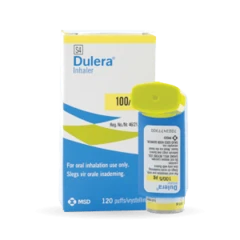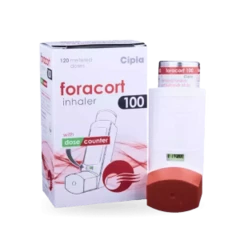
Foracort Inhaler
Asthma, Chronic Obstructive Pulmonary Disease
100mcg + 6mcg · 200mcg + 6mcg · 400mcg + 6mcg
Formulated to alleviate bronchial constrictions to support steady respiration and target mucosal tissue swelling.
Formoterol fumarate is a selective beta2-adrenergic bronchodilator, one of the long-acting beta2-agonists known as LABAs. Its label indicates it for the treatment of asthma and prevention of bronchospasm, but only as concomitant therapy with a long-term asthma control medicine. That condition is not a preference. It is the whole point of the boxed warning.
Asthma, Chronic Obstructive Pulmonary Disease
100mcg + 6mcg · 200mcg + 6mcg · 400mcg + 6mcg
Formulated to alleviate bronchial constrictions to support steady respiration and target mucosal tissue swelling.
The label describes formoterol fumarate as a selective beta2-adrenergic bronchodilator. It relaxes airway smooth muscle, and its long duration is what distinguishes it from the short-acting relievers used to treat symptoms as they happen. That duration is also why it does not substitute for a reliever inhaler in an attack, and why it does not treat the underlying inflammation that a controller medicine addresses.
Asthma-related death. This is the boxed warning. Long-acting beta2-agonists, including formoterol, increase the risk of asthma-related death. Data from a large placebo-controlled US study of another LABA, salmeterol, added to usual asthma therapy showed an increase in asthma-related deaths among those receiving salmeterol, and the label states this finding is considered a class effect of LABAs including formoterol.
The label is candid about the limits of what is known: currently available data are inadequate to determine whether concurrent use of inhaled corticosteroids or other long-term asthma control drugs mitigates the increased risk of asthma-related death from a LABA. That hedge matters, and softening it into “safe when combined with a steroid” would misstate the label.
Never alone in asthma. Because of that risk, use for the treatment of asthma without a concomitant long-term asthma control medication, such as an inhaled corticosteroid, is contraindicated. The label restricts it to additional therapy for patients who are already taking, but are inadequately controlled on, a long-term control medicine, and says it should not be used where asthma is adequately controlled on low or medium dose inhaled corticosteroids.
Stepping down. Once asthma control is achieved and maintained, the label asks that patients be assessed at regular intervals and that therapy be stepped down, discontinuing the LABA if that is possible without loss of control, while the patient stays on a long-term control medicine.
Children and adolescents. Available data from controlled clinical trials suggest that LABAs increase the risk of asthma-related hospitalisation in paediatric and adolescent patients. Where a LABA must be added to an inhaled corticosteroid in this group, the label says a fixed-dose combination product containing both should ordinarily be considered, to ensure adherence to both drugs. Where separate inhalers are used and adherence cannot be assured, a combination product is recommended.
Asthma that is deteriorating, or a need for the reliever inhaler more often than usual, is the pattern the label’s step-down and monitoring instructions exist to catch. Worsening asthma on a LABA is a reason for urgent reassessment rather than an increase in dose.