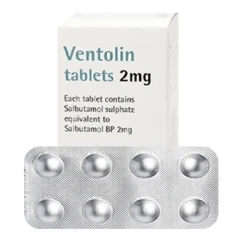
Salbutamol
Salbutamol, called albuterol in the United States, is a short-acting beta2-agonist. Its label indicates it for the relief of bronchospasm in asthma and other reversible obstructive airway disease. It relieves symptoms rather than treating the inflammation behind them, and how often it is needed is itself a clinical signal.
Key points
- The label indicates albuterol tablets for the relief of bronchospasm in adults and children 6 years of age and older with reversible obstructive airway disease.
- The UK summary of product characteristics states that reliance on frequent supplementary use, or a sudden increase in dose, indicates poorly controlled or deteriorating asthma.
- It also warns that overuse of short-acting beta-agonists may mask the progression of the underlying disease and contribute to deteriorating asthma control, leading to an increased risk of severe asthma exacerbations and mortality.
- Maximum plasma concentrations of about 18 ng/mL are achieved within 2 hours, and the drug is eliminated with a half-life of about 5 hours.
How it works
Salbutamol stimulates beta2-adrenergic receptors in airway smooth muscle, relaxing it and opening the airway. The label records that in one study its effect was blocked by co-administration of propranolol, a non-selective beta-adrenergic antagonist, which demonstrates the receptor pathway directly.
Its short action is the point: it works quickly and wears off, which suits relief of symptoms as they occur. It is not a controller, and it does not act on the inflammation that a preventer inhaler treats.
Safety specific to salbutamol
Needing it more often is the warning sign. The UK SmPC states that reliance on frequent supplementary use, or a sudden increase in dose, indicates poorly controlled or deteriorating asthma. This is the most useful fact about the medicine, and it inverts how people often think about a reliever: the inhaler working is not reassurance if you are reaching for it more than you used to.
Overuse masks deterioration. The same document warns that overuse of short-acting beta-agonists may mask the progression of the underlying disease and contribute to deteriorating asthma control, leading to an increased risk of severe asthma exacerbations and mortality. Relief of the symptom is not control of the disease.
Acute severe asthma. Particular caution is advised in acute severe asthma, where the metabolic effects of the medicine may be potentiated by hypoxia and by concomitant treatment with xanthine derivatives, steroids and diuretics.
When to seek urgent care
An increase in how often the reliever is needed, or a sudden increase in the dose required, is what the label identifies as deteriorating control and a reason for reassessment rather than for continuing at the higher rate.
Further reading
Related articles

28 Jul 2026 ⋅ 8 min read
Allergy in the UAE: Dust, Air Conditioning and What Actually Helps
Allergy here is driven by airborne dust and indoor dust mites rather than a pollen season, so symptoms often run year round. What the triggers are, what the treatment classes do, and why the local pharmacy shelf uses names you may not recognise.
Read guide