Key points
- After you inhale it, salmeterol reaches only very low levels in the blood, about 200 picograms per millilitre or less at normal doses, a concentration so small that product information notes it is technically difficult to measure precisely.
- In laboratory tests on human liver tissue, salmeterol was shown to be broken down almost entirely by a liver enzyme called CYP3A4, producing a metabolite called alpha-hydroxysalmeterol.
- Salmeterol carries a boxed warning: long-acting beta2-adrenergic agonists (LABAs) such as salmeterol increase the risk of asthma-related death.
What Salmeterol is used for
Salmeterol is a long-term treatment for Asthma and Chronic Obstructive Pulmonary Disease, taken on a regular schedule because its effect on the airways lasts at least 12 hours. It is not fast enough to relieve a sudden asthma attack, so anyone using a salmeterol inhaler still needs a separate fast-acting reliever inhaler kept close at hand. Because Advair Diskus already contains salmeterol, product information advises against adding another long-acting beta2 agonist, such as formoterol, on top of it.
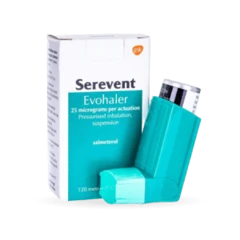
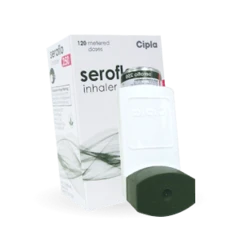
All three formulations in this catalogue are delivered as inhalers. Advair Diskus and Serevent are originator brands from GlaxoSmithKline; Seroflo, manufactured by Cipla Ltd, is an Indian generic line built on the same active ingredient. Two of the three, Advair Diskus and Seroflo, combine salmeterol with the corticosteroid fluticasone propionate; Serevent contains salmeterol on its own, without a steroid added. Advair Diskus and Serevent are catalogued under Respiratory Health; Seroflo sits in the Allergy Relief category instead.
Further reading