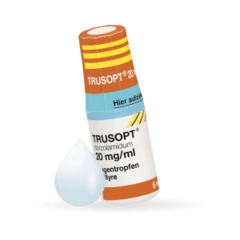
Dorzolamide
Dorzolamide is a carbonic anhydrase inhibitor formulated as eye drops that lower elevated pressure inside the eye. Combined with the beta-blocker timolol as Cosopt, it is indicated for open-angle glaucoma or ocular hypertension in patients not adequately controlled by a beta-blocker alone; the facts on this page describe dorzolamide’s own contribution, not timolol’s. Elevated pressure inside the eye is a major risk factor for optic nerve damage and loss of visual field in glaucoma.
Key points
- Dorzolamide forms a single metabolite, N-desethyl dorzolamide, which inhibits carbonic anhydrase II less potently than dorzolamide itself and also acts on the related isoenzyme carbonic anhydrase I.
- With regular use, dorzolamide builds up in red blood cells by binding to carbonic anhydrase II, reaching a steady state within eight weeks.
- Combining dorzolamide with an oral carbonic anhydrase inhibitor is not recommended, because of the potential for additive systemic effects.
How it works
Dorzolamide is a potent inhibitor of the enzyme carbonic anhydrase II. In the ciliary processes of the eye, inhibiting this enzyme reduces the fluid the eye produces, presumably by slowing the formation of bicarbonate ions and the sodium and fluid transport that follows. Lowering pressure inside the eye matters because elevated intraocular pressure is a major risk factor for optic nerve damage and glaucomatous visual field loss, and the higher that pressure, the greater the likelihood of both.
Safety specific to dorzolamide
Dorzolamide is a sulfonamide, and although it is applied to the eye, it is absorbed into the body, so the same kinds of reactions linked to sulfonamide medicines can occur. Fatalities have occurred, although rarely, from severe sulfonamide reactions including Stevens-Johnson syndrome, toxic epidermal necrolysis, fulminant hepatic necrosis, agranulocytosis, aplastic anaemia and other blood dyscrasias.
Dorzolamide has not been studied in patients with severe kidney impairment (creatinine clearance below 30 mL/min), and because dorzolamide and its metabolite are cleared mainly by the kidneys, it is not recommended for these patients. It has also not been studied in people with liver impairment, so it should be used with caution in that group.
Carbonic anhydrase is also active in the corneal endothelium, and patients with a low endothelial cell count have an increased potential for developing corneal oedema, so caution is needed when using dorzolamide in this group.
The only pregnancy evidence available is from animal studies. In rabbits, dorzolamide produced teratogenic effects at doses that were also toxic to the mother, including malformations of the vertebral bodies, together with reduced maternal weight gain and lower fetal weights; no such malformations appeared at a lower dose that did not cause those maternal effects. There is no adequate data on dorzolamide use in human pregnancy.