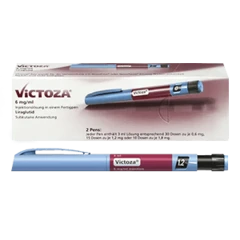
Liraglutide
Liraglutide is an analogue of human GLP-1 that acts as a GLP-1 receptor agonist. Its label covers use in type 2 diabetes, and it carries a boxed warning about thyroid C-cell tumours that decides who can be given it at all.
Key points
- The boxed warning states that liraglutide causes dose-dependent and treatment-duration-dependent thyroid C-cell tumours at clinically relevant exposures in both genders of rats and mice.
- Whether it causes thyroid C-cell tumours, including medullary thyroid carcinoma, in humans is unknown, because the human relevance of the rodent finding has not been determined.
- It is contraindicated in patients with a personal or family history of medullary thyroid carcinoma and in patients with Multiple Endocrine Neoplasia syndrome type 2.
- Unlike native GLP-1, liraglutide is stable against metabolic degradation by peptidases and has a plasma half-life of 13 hours after subcutaneous administration, with absolute bioavailability of approximately 55%.
How it works
The label states that liraglutide is an analogue of human GLP-1 and acts as a GLP-1 receptor agonist. Native GLP-1 is broken down very quickly, and the label contrasts the two directly: GLP-1 has a half-life measured in minutes, while liraglutide is stable against metabolic degradation by peptidases and has a plasma half-life of 13 hours after subcutaneous injection. That stability is what makes once-daily dosing possible.
Safety specific to liraglutide
Thyroid C-cell tumours. This is the boxed warning, and the way it is phrased matters more than a summary would suggest.
Liraglutide causes dose-dependent and treatment-duration-dependent thyroid C-cell tumours at clinically relevant exposures in both genders of rats and mice. The label then states plainly that it is unknown whether it causes thyroid C-cell tumours, including medullary thyroid carcinoma, in humans, because the human relevance of the rodent finding has not been determined.
Both halves have to travel together. Reporting only the rodent finding overstates what is known; reporting only the uncertainty understates why the contraindication exists.
Who cannot take it. It is contraindicated in patients with a personal or family history of medullary thyroid carcinoma, and in patients with Multiple Endocrine Neoplasia syndrome type 2. Family history is part of that, so it is a question worth answering accurately rather than approximately.
What patients are told to watch for. The label asks that patients be counselled about the potential risk of medullary thyroid carcinoma and informed of the symptoms of thyroid tumours: a mass in the neck, difficulty swallowing, difficulty breathing, or persistent hoarseness.
Monitoring does not solve it. The label states that routine monitoring of serum calcitonin, or the use of thyroid ultrasound, is of uncertain value for early detection of medullary thyroid carcinoma in patients treated with liraglutide. That is an unusual admission on a label, and it is the reason the contraindication does the work instead.
When to seek urgent care
A mass in the neck, difficulty swallowing, difficulty breathing, or persistent hoarseness are the specific symptoms of thyroid tumours the label asks patients to be informed about, and they warrant medical assessment rather than waiting.